


Hallucigenia sparsa
Morris, 1977
Middle Cambrian
Burgess Shale
British Columbia, Canada
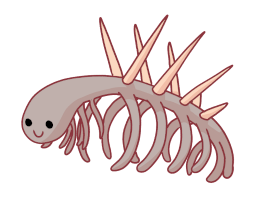
Hallucigenia is a kind of worm possessing pairs of leg-like extensions of the body, and paired spines on the dorsal surface. Its name was coined in reference to this dreamlike appearance and also reflected the organism's uncertain affinities.
The contrast between the specimen and the matrix has been enhanced by a chemical process that removed some of the matrix overburden. Since the specimen is typically covered with resistant mica and is composed of the carbonized remains of the animal, it is inert to the treatment.
27mm specimen on 73mm slab. The silver shine is there, but a bit worn, maybe because it was found as loose rock (float) rather than a split pair.
Acquisition: 2022-09-02
Burgess Shale
Discovered in 1911 by Charles Walcott, the fossils site of Burgess contains the remains of a marine biotope, composed of several species, of various forms and sizes. It is famous for the exceptional preservation of the soft parts of its fossils, which allowed for a detailed study of anatomy of worms, arthropods and other misunderstood forms at the time.
Early 1970, 3 british paleontologists, Harry Whittington, Derek Briggs and Simon Conway Morris began a thorough reassessment of the Burgess Shale. They realised that the fauna was much more complex and unusual than formerly described. Thus was discovered the Cambrian explosion phenomenon, popularized by Stephen Jay Gould's "Wonderful Life" book.
Before this bloom of diversity of body plans, most of living organisms were composed of individual cells living in colony. Cambrian sees the sudden appearance of all modern animal phyla, including our own one, almost simultaneously in a rather short span of geological period.
Today the Burgess shale is a UNESCO World Heritage site and no collection is allowed on-site. However, prior to the Royal Ontario Museum rediscovering Walcott's collection in 1966, there was a period of over 50 years when Canadian researchers didn't have any interest in the site. During that time, it was an interesting curiosity that was open to collecting and a wide variety of teachers, collectors, hobbyists and the like visited the site and collected specimens.
The fossils presented on this website are coming from these existing private collections of Burgess Shale material, especially from a collection of Lowell Laudon, as well as from specimens sent by Walcott himself to other geologists.